Saturday, September 22, 2012

Cakes, old and new friends

Saturday - onwards to Melbourne. Sarah Sakaguchi (a Cranfield Masters graduate) picked me up from the airport and we went off to St Kilda for brunch, a walk and cakes!

 So many cakes, so little time

 Sarah with cakes :)

Sunday was a day of catching up with other old friends, this time two Otago grads Gemma Radford and Sarah Weller; time for brunch.

Sarah, me and Gemma at Yellow Bird

Don't want you to think the week was one long brunch ;) My visit to Melbourne hit four places in four days. Monday and Wednesday had a defence orientation at DSTO and Diggerworks respectively. At both organisations I gave presentations, presented more Churchill coins and had meetings with old and new Australian colleagues. Thanks to Horace, Bin, Sarah and Annette.

On Tuesday I visited the Victorian Institute of Forensic Medicine to learn about how clothing is dealt with in the mortuary and particularly how damaged clothing in handled and packaged ready for forensic scientists to examine. I was invited to give a lecture and had an opportunity to present a Churchill coin to the team :)

 The Mortuary Team

Thursday, I was out at the Textiles Department of RMIT. I've known Mac Fergusson for a few years having met him at The Textiles Institute conference in 2010. Mac has worked with AFP on textile damage projects and is also involved in the book edited by James and Jane. He is supervising a MSc candidate Libby, who we hope will come to Shrivenham to spend some time working with us on a very interesting forensics project - Libby's in the process of presenting the work at the ANZFSS this week in Hobart. I had an opportunity to present to staff and students from RMIT with some outside guests from DSTO and CSIRO. Mac and I exchanged a Churchill coin for a very nice bottle of Aussie shiraz!

Mac and I at RMIT

A highlight of my week in Melbourne was dinner with some local Churchill Fellows. Thank you SO much Ben, Shane, Janine and Lou.


 Lou, me and Janine

Finally, a few pics from Melbourne:


Hair, textile damage and a little sightseeing

Apologies for the lack of posts; I've had a laptop disaster "Hard drive failure imminent"! Anyway, I'm now at a friends place in Sydney so have chance to up date my blog :)

The rest of my time in Canberra was spent with Professor James Robertson at the University of Canberra and Dr Jane Hemmings (and Team) at Australian Federal Police. I also had chance to do a little sightseeing :)

James, Jane and I discussed a book chapter we are collaborating on.

At UoC I sat in on a first year laboratory in hair analysis taught by James, I wonder if the students realised how lucky they are to have him teaching them. I had a chance to chat with the students about their aspirations and we talked about the differences in teaching / degrees between AUS and UK. I also sat in on a lecture James gave to a mixture of forensic and law students So you think you know about forensic science - very interesting and some useful pointers for my own lecturing. I was lucky to be able to participate in an AFP training course on hair examination.

At AFP I was invited to give a lecture and I had a chance to understand how evidence is submitted for examination and the process by which textile damage is assessed.

Lecture at AFP

After the lecture I had a chance to discuss with the Textile Damage team a case of ripped knickers, the damage observed in both the actual garment and the recreations was very similar to laboratory based work we are currently conducting at Shrivenham. This is important because it means we might be able to answer the question "how hard were they pulled off the person".

I handed out my first Churchill coins to James and Jane to thank them for looking after me during the week.

Jane, James and I with Churchill coins

Some general pics from Canberra:


Thursday, September 13, 2012

Winston, harakeke and muddy socks

Well, I'm in Canberra :) Flights etc. were just fine and the city is lovely. The weather's been fantastic although some of the locals tell me it's cold! Typically it's been -2 deg. C overnight and 20 (ish) deg. C during the day.

I popped in to meet the folk at the WCMT Office here; they're based on the ANU campus. Paul and his team were incredibly welcoming and we had a great chat about the WCMT in the two countries and my Fellowship.

 Paul and I with Winston Churchill by Ante Dabro (2001)

Winston at ANU

As I was walking out of the ANU campus Paul's parting words of "Take any opportunity" presented themselves in the form of the Textiles Department building. I suddenly remembered a good friend of mine, Rokahurihia Ngarimu-Cameron, telling me there was harakeke (Phormium tenax, NZ flax) planted on the campus and she had held raranga wanaga there (weaving workshops). You can see some of Roka's stunning work here. As I chatted to a visiting scholar from South Africa there (screen printing), one of the students, Tara Bromham, came and kindly showed me some of the harakere, turns out she had taken part in the wanaga. You can see some of Tara's work here.

Tara with harakeke

Next stop was a date at the Conservation Department of The Australia War Memorial. Even though my Fellowship is in Forensic textile science I have an interest in materials science in conservation and a friend of mine, Tharron Bloomfield, mentioned I should try to call in on the Conservation Department. I had the opportunity to meet with both textile and painting conservators, specifically Cathy Challenor, Alana Treasure and Jessie Firth. Turns out there was a great connection to some work a MSc graduate of mine Jemma Mitchell has recently done at Cranfield and will be doing in the future for her PhD. There were some objects, including shirt fragments and socks, in the conservation laboratory from the Fromelles Project. We enjoyed chatting about the rarity of recovered buried textiles (moden ones that is). Hoping this visit might lead to some interesting collaboration and some projects for future MSc candidates at Cranfield. Cathy showed me aound the laboratories, fantastic facility. I hope that staff from the AWM might come visit us at Cranfield soon.

 Shirt fragments

Inner and outer sock

I visited The AWM itself and wondered up and down ANZAC parade admiring the various memorials placed there. I think my favourites were the Diggers and the Nurses.

 The Diggers

 Very interested in the overseas visitor

 Inscription by AUS-NZ memorial

 AUS-NZ

 AWM

From AWM to Parliament down ANZAC Parade


Monday, August 20, 2012

Ribs, fabric and bullets

Started the research last week that I'll be finishing with Liz Girvan at The University of Otago in September and October as part of my Fellowship.

The aim of the work is to investigate debris in bony wounds - specifically ribs and is in collaboration with Professor Jules Kieser at Otago.

The work is considering clothing layers mounted on pig thoracic wall (skin, underlying tissue, ribs). We've been shooting at them using 9 mm x 19 mm FMJ and .357" Remington Magnum ammunition from a distance of 5 m. A great team effort with assistance from Dave Miller and Mike Teagle (Small Arms Experimental Range), and Alex Mabbott (one of our PhD candidates), Charlotte Mott (summer intern) and Steve Champion.

A couple of pictures for you to wet the appetite for when the paper is published :)


Wound Ballistics 12

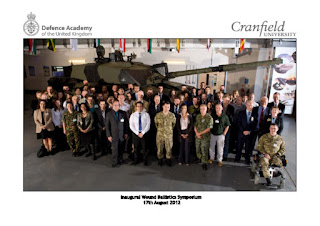
On Friday (17 August 2012) Cranfield Defence and Security hosted an inaugral Wound Ballistics Symposium. My colleague Steve Champion and I have been talking about organsing this for around a year, and a visit from two researchers from New Zealand promoted us to put a date in the diary. All of the administration was wonderfully arranged by the Symposia at Shrivenham Office (thanks again to Michael, Lynn and Ryan). Sixty-seven attendees were treated to eight incredibly interesting invited presentations:


Keynote – From WOUNDMAN to COMPUTERMAN: A Whimsical Exploration. Leslie Payne, Ballistic Injury Archives.
Indirect Ballistic Skeletal Fracture: Can your Femur Fracture Even if a Bullet Does Not Hit the Bone? Captain Dr David Kieser, New Zealand Orthopaedic Association and New Zealand Defence Force.
Wound Ballistic Research: A Morphoscopic Approach. Professor Jules Kieser, University of Otago, New Zealand.
Design Validation of Future Cervical Ballistic Protection for the UK Soldier through the Development of a Novel Injury Model. Major Johno Breeze, Royal Centre for Defence Medicine.
A Forensic Investigation of Confined Space Blast. Dr Hasu Patel, Barts and The London and Steven Dryden, Metropolitan Police Service.
The 1968 Firearms Act: Minimum Lethality Requirements. Dr Derek Allsop, Cranfield University.
Examining the Consequences of Blast Injury to the Male External Genitalia. Wing Commander Davendra Sharma, St George’s Hospital.
Parametric Study on the Effect of Calibre on Wound Track, a Numerical Approach. Dr Amal Bouamoul, Defence Research and Development Canada.


A couple of pics (delegates, presenters; Crown Copyright, courtesy of Serco at the Defence Academy):